

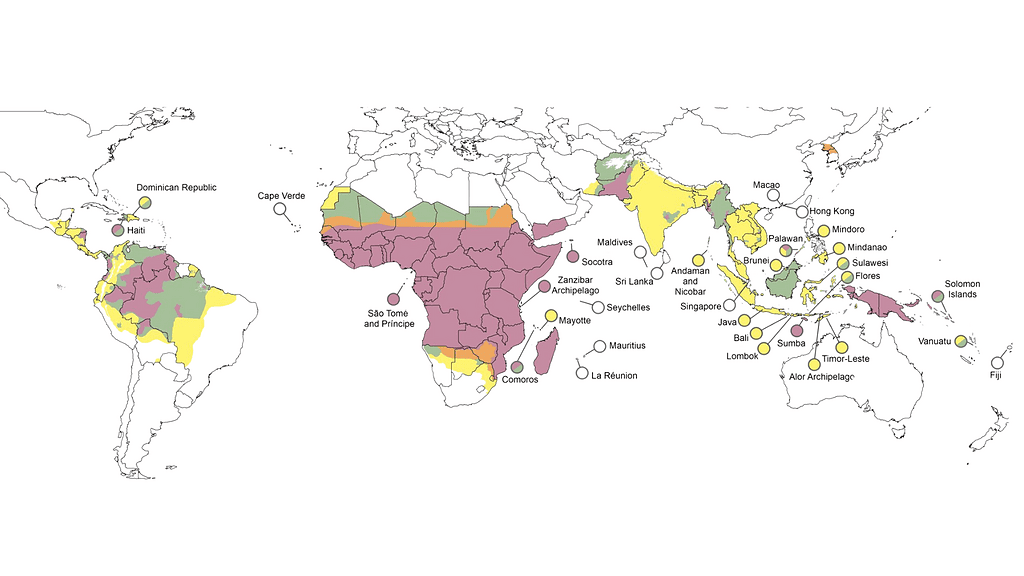
The malaria map explained: here's how to estimate your risk
You've probably heard of the malaria map if you're planning a long-haul trip. But what do all those colours and codes actually tell you? And more importantly, how do you use such a map to determine whether you need malaria pills or whether good mosquito control is enough? In this blog, we explain step by step how to read and interpret the malaria map. This will help you better assess your risk and which protective measures are appropriate for your specific trip. Because not every trip to an ‘orange’ area requires the same approach.
Why do we work with a malaria map?
Malaria does not occur everywhere in the world, and even within countries with malaria, the risk varies enormously by region, season and environment. A malaria map gives you at-a-glance insight into:
- Where malaria occurs
- How high the risk is
- Whether resistance to certain drugs occurs
- Which malaria species (Plasmodium) is dominant
This will allow you to make the right choices based on your destination, length of stay and travel season.
The colour codes on the malaria map
Green or white - No malaria
- Malaria does not occur (anymore)
- No protection needed
- Examples: Europe, North America, Australia
Yellow - Very low risk
- Malaria occurs sporadically
- Risk especially in remote areas or specific seasons
- Mosquito control is usually sufficient
- Examples: some parts of India, certain coastal areas
Orange - Moderate risk
- Malaria occurs regularly
- Depending on your travel profile, prophylaxis may be needed
- Good consultation with travel consultant essential
- Examples: parts of Southeast Asia, certain areas of East Africa
Red - High risk
- Malaria is common
- Malaria pills strongly recommended or mandatory
- Good mosquito control remains essential
- Examples: large parts of sub-Saharan Africa, Amazon region
Note: These are general guidelines. Always check Vaccination Point's up-to-date malaria maps for the latest information.
Reading the malaria map: more than just colours
A coloured map is a starting point, but for proper risk assessment, you need to look deeper:
- Specific region within the country
A country can be part green and part red. Are you going to Bangkok or the north of Thailand? That makes a huge difference.
Tip: Zoom in on your exact destination and don't just look at the country level. - Urban versus rural
Malaria mosquitoes mainly live in rural areas. Large cities often have no or very low risk, even in malaria-prone countries.
Example: Nairobi (Kenya) has hardly any malaria, but the safari areas do. - Season and climate
Malaria often peaks during and shortly after the rainy season, when there is more stagnant water where mosquitoes breed.
Note: An orange area in the dry season may have a lower risk than that same area in the monsoon season. - Height above sea level
Above 2,000-2,500 metres, malaria is rare because malaria mosquitoes do not survive well there.
Example: Addis Ababa (Ethiopia, 2,400m altitude) does not have malaria, but lower parts of Ethiopia do. - Type of accommodation and activities
- Will you stay in a well-sheltered lodge or camp in the bush?
- Will you go on an evening safari or stay in?
- Do you sleep under an impregnated mosquito net?
These factors greatly affect your actual risk.
From map to action: what protection do you need?
Now that you understand the malaria map, the question is: what do you do with it?
Scenario 1: Green area
✓ No need for malaria pills
✓ Do check other travel vaccinations if necessary
Scenario 2: Yellow area (very low risk)
✓ Usually no prophylaxis needed
✓ Good mosquito control though essential:
- Mosquito net if required
- DEET 30-50%
- Long clothing in the evening
Scenario 3: Orange area (moderate risk)
⚠️ Situation-dependent - discuss with our travel experts:
- Length of stay (1 week vs 3 months)
- Type of trip (luxury resort vs backpacking)
- Season
- Personal health situation
Possible advice: prophylaxis + mosquito control
Scenario 4: Red area (high risk)
✓ Malaria pills strongly recommended
✓ Intensive mosquito control
✓ Carry standby medication if necessary
✓ Good travel insurance
Important: View the specific malaria areas for your destination to know exactly what is recommended.
Which malaria pills suit your trip?
If prophylaxis is advised, several types of malaria pills are available. Which one suits your trip best depends on the resistance pattern in your destination, the duration of your trip, your medical history and any side effects. A travel advisor from Vaccinatiepunt will discuss all the options with you and help you make the right choice.
Why professional advice is indispensable
The malaria map is a valuable tool, but it is only one piece of the puzzle. Professional travel advice looks at:
✓ Your complete itinerary (including short stops in high-risk areas)
✓ Current developments (outbreaks, resistance)
✓ Your health (pregnancy, chronic conditions, age)
✓ Previous travel experiences and medication use
✓ Combination with other required vaccinations
Want to know exactly what malaria risk you face?
👉 See the up-to-date malaria maps for your destination
👉 Read more about specific malaria areas worldwide
👉 Schedule a travel consultation At Vaccination Point for personal advice
Frequently asked questions about the malaria map
How often are malaria maps updated?
Good malaria maps are updated several times a year based on data from WHO, CDC and local health departments. Always check the date on the map and use recent sources.
Can risk vary widely within a country?
Absolutely. For example, Thailand: Bangkok has no malaria, but jungle areas in the north do. Therefore, always look at regional level, not just countrywide.
Do malaria pills protect for 100%?
No, malaria prophylaxis reduces the risk by 85-95%, but does not provide an absolute guarantee. Therefore, mosquito control always remains necessary, even with pills.
